


Did you know IBM’s latest quantum processor, ‘Osprey‘, has 433 qubits? This is a huge jump from its 127-qubit predecessor in just one year. Such fast progress in quantum computing is changing how we process data and what we think is possible in tech.
Table of Contents
The race to use quantum computing is moving fast. IBM wants to have over 4,000 qubits by 2025. This goal is pushing the limits of what we can do with electronics. It could solve problems we thought were impossible.
We are on the edge of a new computing era. These advancements will change many industries. Qubit quantum computers will help find new medicines and make complex financial models better. They are combining quantum science with advanced tech for big breakthroughs in solving problems.
Uncover more about Quantum Computing!
Key Takeaways
- ⚙️ IBM’s Osprey processor features 433 qubits, tripling previous capabilities
- 🧩 Quantum computing aims to solve previously unsolvable problems
- 🚀 IBM plans to reach 4,000+ qubits by 2025
- 🌡️Qubit systems operate at near absolute zero temperatures
- 💻 Quantum computers process information using superposition for parallel computing
- 💵 The quantum computing industry is projected to reach $1.3 trillion by 2035
Understanding Qubits
Qubits are key in quantum information theory. They are different from classical bits because of their unique properties. These properties are vital for quantum mechanics and advanced computing.
Fundamental Properties of Qubits
Qubits are the basic units of quantum computers. They can be in more than one state at the same time, known as superposition. This is unlike classical bits, which can only be in one state.
- Spin qubits use up and down orientations to represent 0 and 1
- Trapped atoms and ions qubits rely on electron energy states
- Photon qubits utilize polarization, path, or time to encode information
- Superconducting circuits qubits operate based on current flow direction
Quantum States and Superposition
Superposition is a key idea in quantum information theory. It lets qubits be in many states at once. This greatly boosts their computing power.
This power lets quantum computers solve complex problems that classical computers can’t. It’s a big reason why quantum computers are so exciting.
| Property | Classical Bit | Qubit |
|---|---|---|
| Possible States | 0 or 1 | 0, 1, or Superposition |
| Representation | Electrical or Physical | Atoms, Ions, Photons, Electrons |
| Environment | Room Temperature | Extreme Refrigeration |
| Computational Power | Limited | Exponentially Higher |
Getting to know qubit states is essential for quantum mechanics and powerful quantum computers. These computers could change many fields, like medicine, climate modeling, and artificial intelligence.
Qubit Architecture and Design
Qubit quantum computers use new designs to process information. Recent breakthroughs have made these systems more efficient and reliable.
Physical Implementation of Qubits
Researchers at MIT have made big steps in qubit design. Their design is very accurate, with two-qubit gates over 99.9% precise and single-qubit gates at 99.99%. They use fluxonium qubits, which last over a millisecond – ten times longer than others.
The MIT team’s work shows quantum information flow is correct over 96% of the time. Their module, with four qubits, can emit photons precisely. This helps us move towards building bigger quantum processors (Dive deeper into quantum processors: Quantum Processor Revolution).
Different Types of Qubit Systems
There are many qubit systems, each with its own features:
- Superconducting qubits
- Trapped-ion qubits
- Semiconductor-based qubits
- Topological qubits
- Photonic qubits
Brookhaven National Laboratory scientists have created a new qubit design. It’s better for making lots of qubits and works as well as others. They pick materials and adjust sizes to improve qubit performance.
“Our goal is to create a qubit architecture that meets quantum computing needs while aligning with existing electronics manufacturing capabilities,” – Mingzhao Liu and Charles T. Black, researchers at Brookhaven National Laboratory.
These advances in qubits bring us closer to making big, useful quantum computers. As research goes on, we’ll see better qubit performance and system efficiency.
Quantum Information Processing
Quantum information processing uses quantum mechanics for computing. It offers exponential speedups for certain tasks over classical computers. The heart of this tech is quantum gates and operations, which work with qubits to run complex algorithms.
Quantum Gates and Operations
Quantum gates are the basic parts of quantum circuits. They differ from classical logic gates because they use superposition and entanglement. A universal set includes single-qubit rotations and multi-qubit gates like CNOT.
These gates help run powerful algorithms like Shor’s prime factorization and Grover’s search algorithm.
The quality of quantum gates is key. High gate fidelity means accurate quantum information. This is crucial for quantum supremacy, as shown by Google AI and NASA in 2019 with a 54-qubit machine.
Measurement and Control Systems
Measurement and control systems are essential in quantum computing. They let us start qubits, apply quantum operations, and read results. Advanced measurement techniques help spot and fix errors, making quantum computing fault-tolerant.
Quantum error correction is a big part of these systems. It uses ancilla qubits to encode quantum information, protecting it from noise and errors. This method ensures accurate computation and moves us towards large-scale quantum computers.
“The entanglement of individual molecules in 2023 marks a significant milestone for quantum computing applications.”
As quantum information processing improves, it opens new doors in cryptography, optimization, and scientific simulations. The mix of quantum gates, operations, and advanced measurement systems is leading us to a future with unmatched computing power.
Managing Quantum Coherence
Quantum coherence is key to quantum computing. It lets qubits be in many states at once. But, this state is fragile and can be lost, causing decoherence.
Decoherence Challenges
Keeping qubits in the right state is hard. Things like temperature changes and particles can mess with them. This affects how long a qubit can keep information.
Preservation Techniques
Scientists are finding new ways to fight decoherence. They use:
- Dynamical decoupling schemes
- Environmental shielding
- Quantum error mitigation
- Quantum error correction
Quantum error correction is very promising. It spreads data across qubits to protect it. Making this work for more qubits is key to better quantum machines.
“Quantum error correction plays a vital role in realizing the potential of large-scale quantum computing within the rapidly advancing field of quantum technology.”
Research is leading to big steps forward. Quantum Machines’ OPX quantum controller™ links classical and quantum systems better. Their OPX1000 is a big step, handling thousands of channels.
Entanglement in Qubit Systems
Quantum entanglement is a fascinating phenomenon at the heart of qubit systems. It allows entangled qubits to stay connected, no matter the distance. This opens up exciting possibilities for quantum applications.
Creating Entangled States
Scientists have made big strides in creating entangled states. In a groundbreaking experiment, researchers entangled 16 superconducting qubits using microwave technology. This shows the potential for growing quantum systems.
Making entangled states is complex. For example, in the IBM Q Poughkeepsie device, scientists got full entanglement in a 20-qubit graph state. This achievement shows the progress in quantum entanglement techniques and their practical uses.
Applications of Entanglement
Quantum entanglement has many applications across various fields. In quantum computing, it makes some algorithms faster than classical ones. It’s also key for quantum communication and sensing technologies.
| Application | Description | Potential Impact |
|---|---|---|
| Quantum Computing | Enables faster processing of complex calculations | Revolutionize drug discovery and financial modeling |
| Quantum Communication | Allows for secure data transmission | Enhance cybersecurity and privacy protection |
| Quantum Sensing | Improves measurement precision | Advance medical imaging and navigation systems |
As research in quantum entanglement keeps advancing, we’ll see more innovative quantum applications. These will change various industries and push the limits of computing and communication.
Quantum Error Correction
Quantum error correction is key to making quantum computers reliable. It keeps quantum information safe from errors and noise. This is crucial for accurate quantum calculations.
Error Detection Methods
Quantum systems use special measurements to find errors without messing up the data. This is different from how classical computers work. In quantum computing, you can’t just copy information like you can in classical computers.
The no-cloning theorem in quantum mechanics explains why. It says you need to spread information across many qubits to keep it safe.

- Bit flip code: Fixes bit errors in logical qubits
- Sign flip code: Deals with phase errors
- Shor code: Handles both bit and sign flip errors with nine qubits
Fault-Tolerant Computing
To make quantum computers fault-tolerant, a lot of resources are needed. It’s estimated that about 1000 physical qubits are required for one logical qubit. Companies like IBM and Google are working on this, aiming for systems with 1000+ qubits.
| Error Correction Method | Qubits Used | Errors Corrected |
|---|---|---|
| Shor Code | 9 | Bit flip and phase flip |
| Steane Code | 7 | Bit flip and phase flip |
| Surface Code | Variable | High threshold, promising for large-scale |
Q-CTRL’s quantum firmware has made big improvements in cloud quantum computers. It has reduced the qubits needed for error correction and improved qubit stability against noise and decoherence.
Scaling Qubit Systems
Scaling quantum computers is a big challenge. Researchers are working hard to increase the number of qubits. They face many limits in quantum computing that they must overcome.
Current Technological Limits
Today, quantum computers can handle only a few hundred qubits. But to make quantum computing reliable on a big scale, we need to control millions of qubits at once.
| System Type | Qubit Control Range |
|---|---|
| Current Systems | 1 – 1,000 qubits |
| Fault-Tolerant Systems | 100,000 – 1,000,000 qubits |
Strategies for Scaling Up
Researchers are finding new ways to make quantum computers bigger. IBM wants to build a 100,000-qubit system by 2033. They are working on better communication, software, algorithms, and ways to fix errors.
- Modular architectures for easier scaling
- Improved quantum communication technologies
- Miniaturization of control components
- Development of sideband frequencies for flexible qubit connections
The University of Tokyo is leading in scaling quantum algorithms. They are building a community around quantum computing. The University of Chicago is working on quantum communication. They have a 124-mile quantum network for long-distance communication.
These efforts aim to break through current limits. They hope to create big quantum computers that can solve problems that classical computers can’t.
Programming Quantum Computers
Quantum software development is changing how we compute. As quantum tech gets better, new tools and languages are coming out. This opens up new ways to solve complex problems.
Quantum Programming Languages
Quantum programming languages are essential for quantum computers. They let developers write algorithms that use quantum properties like superposition and entanglement. Qiskit from IBM and Cirq from Google are popular choices.
These tools help programmers write and run quantum code. They can use simulators or real quantum hardware.
Development Tools and Frameworks
The quantum software world is growing fast. Frameworks like IBM’s Qiskit Runtime make quantum programming easier. They hide complex quantum details, letting users focus on solving problems.
Microsoft’s Quantum Development Kit (QDK) is another powerful platform for quantum coding. These tools are key for advancing quantum apps. They help researchers and developers work on quantum algorithms for optimization, simulation, and machine learning.
As quantum hardware gets better, these software tools will be crucial. They will help achieve quantum advantage in many industries.
“Quantum programming is not just about writing code, it’s about reimagining computation itself.”
The field of quantum programming is changing fast. More developers are learning quantum languages and tools. We can expect to see amazing new applications soon. The future of computing is quantum, and we’re just starting this exciting journey.
Hybrid Computing Approaches
The future of computing is about combining classical and quantum systems. Hybrid quantum-classical systems are leading to big leaps in processing power and solving complex problems.
Classical-Quantum Integration
Quantum-classical integration is changing the computing world. Companies like Airbus, BMW Group, and Thales Group are working together. They aim to solve big challenges that both classical and quantum computers can’t handle alone.
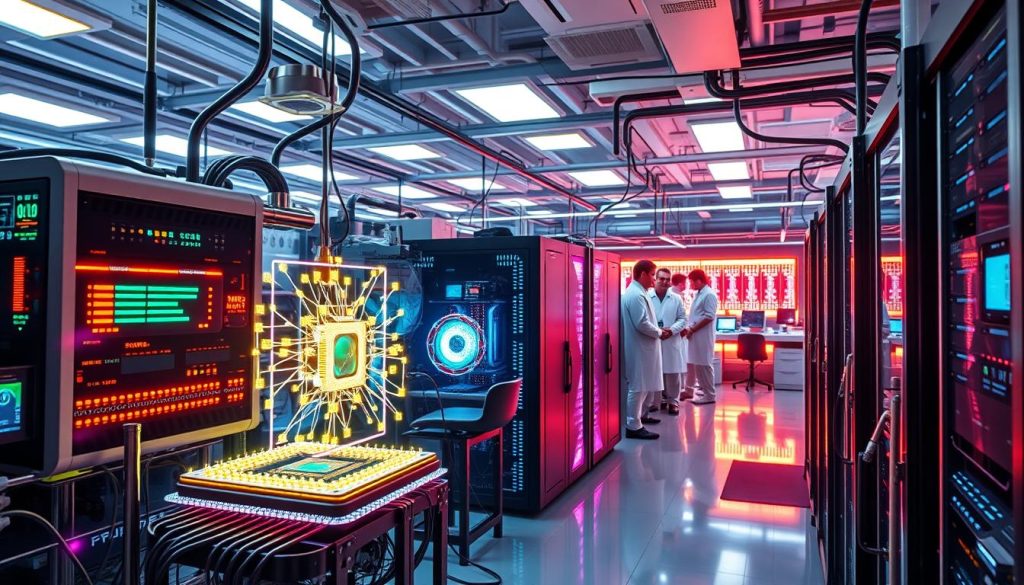
Variational quantum algorithms (VQAs) are key in this new field. They work with NISQ devices, which have up to a thousand qubits. VQAs use both classical and quantum computing to solve tough problems efficiently.
Optimal Workload Distribution
It’s important to balance workloads between classical and quantum processors. Batch quantum computing makes sending jobs faster by grouping them together. This cuts down wait times and speeds up processing for many tasks.
Sessions in hybrid quantum-classical systems help organize and track jobs better. They let classical code run between quantum jobs, making things more efficient. Jobs in sessions get priority, which boosts system performance.
“A first quantum advantage for an industrially relevant problem is expected to be achieved through a hybrid quantum-classical combination.”
As hybrid quantum-classical systems grow, they open up new possibilities in many fields. The mix of quantum and classical computing is set to change what’s possible in computing.
Industrial Applications
Quantum computing is changing fast, with new uses in many fields. We’re seeing how it’s set to change industries all over the world.
Current Use Cases
Quantum computing is making a big splash in finance and pharma. Banks are using it to better manage risks and improve investments. Drug makers are speeding up their research with quantum tools.
In logistics, quantum tech is making supply chains more efficient. This is just the start of what’s possible.
In 2023, quantum tech got over $1 billion in funding. Most of this money went to making quantum computers better.
Future Implementation Plans
The future of quantum computing looks bright. It could add nearly $1.3 trillion to the economy by 2035. Companies are putting a lot of money into quantum tech.
Big names like IBM and Google are leading the charge. The market is expected to grow to $8.2856 billion by 2032. This growth will lead to new uses in security, AI, and finance.
“Quantum computing is like the Wright brothers’ first flight. We’re at the very beginning of a very exciting journey,” said a leading tech CEO, highlighting the transformative potential of this technology.
As quantum computing grows, it will change how we solve problems in many fields. It’s an exciting time for tech.
Quantum Networking
Quantum networking is a big leap in how we send data. It uses quantum mechanics to send information between devices. Unlike old networks, it uses special particles called qubits to carry data.
Quantum Internet Possibilities
The quantum internet is going to change things. It won’t replace our current internet but will add new features like quantum cryptography. Experts say we might see quantum networks across the US in 10-15 years.
These networks could make financial analysis, data encryption, and material science research much better.
Researchers have made great strides in quantum communication. They’ve tested a 54-mile quantum network loop in Chicago using fiber-optic cables. Now, it’s 124 miles long with six nodes, one of the longest in the country.
They’re also looking into using satellites for quantum communication.
Secure Communication Systems
Quantum networking is super secure. It uses special connections called entanglement to protect data. This is key for sending sensitive information.
IBM and Vodafone are working on ultra-secure communication systems. They’re using quantum-safe cryptography.
But, quantum networking has its challenges. Sending data over long distances can mess with qubits. We need quantum repeaters to fix this. Also, we need to agree on how to use it, which is hard.
Setting up quantum infrastructure in data centers will take a lot of money and time.
“Quantum networking is not just an evolution, it’s a revolution in how we think about data transmission and security.”
Future Developments
The world of quantum computing is buzzing with excitement. Future quantum computers promise to revolutionize technology. Researchers are making quantum research breakthroughs at a rapid pace, pushing the boundaries of what’s possible.
Next-Generation Architectures
IBM’s Quantum Heron marks a big leap forward. It can now run complex quantum circuits with up to 5,000 two-qubit gate operations. This boost in power means tasks that once took 112 hours now take just 2.2 hours – that’s 50 times faster! These advancements are paving the way for more powerful and efficient quantum systems.
Research Breakthroughs
The Quantum Systems Accelerator (QSA) is leading the charge in quantum R&D. They’ve built quantum simulators with 250 atoms, opening doors for modeling next-gen batteries and solar cells. At Duke University, researchers used a trapped ion quantum computer to mimic a complex molecule experiment. This shows how future quantum computers could transform chemistry and drug discovery.
RIKEN and Cleveland Clinic are teaming up to explore quantum algorithms for chemistry problems. Their work on the IBM Quantum System One could lead to breakthroughs in drug design. As quantum tech grows, we can expect to see more real-world applications that could change our lives for the better.
FAQ
What is a qubit in quantum computing?
A qubit is the basic unit of quantum information. It can be atoms, ions, photons, or electrons. Unlike classical bits, qubits can be in many states at once. This lets quantum computers solve some problems much faster.
How many qubits does IBM’s latest quantum processor have?
IBM’s latest processor, called ‘IBM Osprey’, has 433 qubits. This is three times more than the 127 qubits in the IBM Eagle processor from 2021.
What are quantum gates?
Quantum gates are like the logic gates in classical computers but for quantum circuits. They use superposition and entanglement, which classical gates can’t. A universal set includes single-qubit rotations and multi-qubit gates like CNOT or C-Phase.
What is quantum coherence?
Quantum coherence is key for quantum information technology. It’s when a quantum system keeps its quantum state. Longer coherence times mean better performance and accuracy.
What is quantum entanglement?
Quantum entanglement is when particles stay connected, even over long distances. Actions on one particle affect the other. This is crucial for quantum computing and makes some algorithms better than classical ones.
Why is quantum error correction important?
Quantum error correction is vital for reliable quantum computers. It helps deal with noise and errors. This makes quantum computations more accurate and reliable.
What are some challenges in scaling qubit systems?
Scaling qubit systems is hard due to size, qubit quality, and control electronics. Researchers are exploring modular designs and better communication to overcome these challenges.
What are hybrid quantum-classical approaches?
Hybrid approaches mix classical and quantum computing. They aim to use each technology’s strengths. This way, they can solve problems more efficiently.
What industries are exploring quantum computing applications?
Many industries are looking into quantum computing. Bosch is exploring new uses, Vodafone is working on secure cryptography, and Crédit Mutuel Alliance Fédérale is in finance.
What is quantum networking?
Quantum networking aims to create a quantum internet. It could enable secure, long-distance communication and distributed computing. This could change how we send data and do global computations.
What are some future developments in quantum computing?
Future developments include new architectures and research breakthroughs. For example, Stanford University is working on mechanical devices in the quantum realm. The Illinois Quantum and Microelectronics Park is also advancing quantum science.
Sources: IBM